
Last Reserve – the card game
Experience the circular economy at ABU.
The class shares a stock of raw materials that does not replenish itself. Each team runs a training business and decides round by round: should they buy cheaply for as long as possible, or invest in repairing, reusing and rethinking? Anyone who only thinks of themselves will deplete the stock for everyone.
We are looking for teachers who would like to try out the game with their class.
At a glance

2 × 45 minutes
as a double lesson or split into two lessons; the game can be paused at any time

16–28 apprentices
in 4 to 6 teams, with each team running a business from a different sector

ABU, all professions
Can be played without prior knowledge; suitable for economics, politics and ecology

In the browser
A projector for the class, one laptop per team, no installation required
How the game works
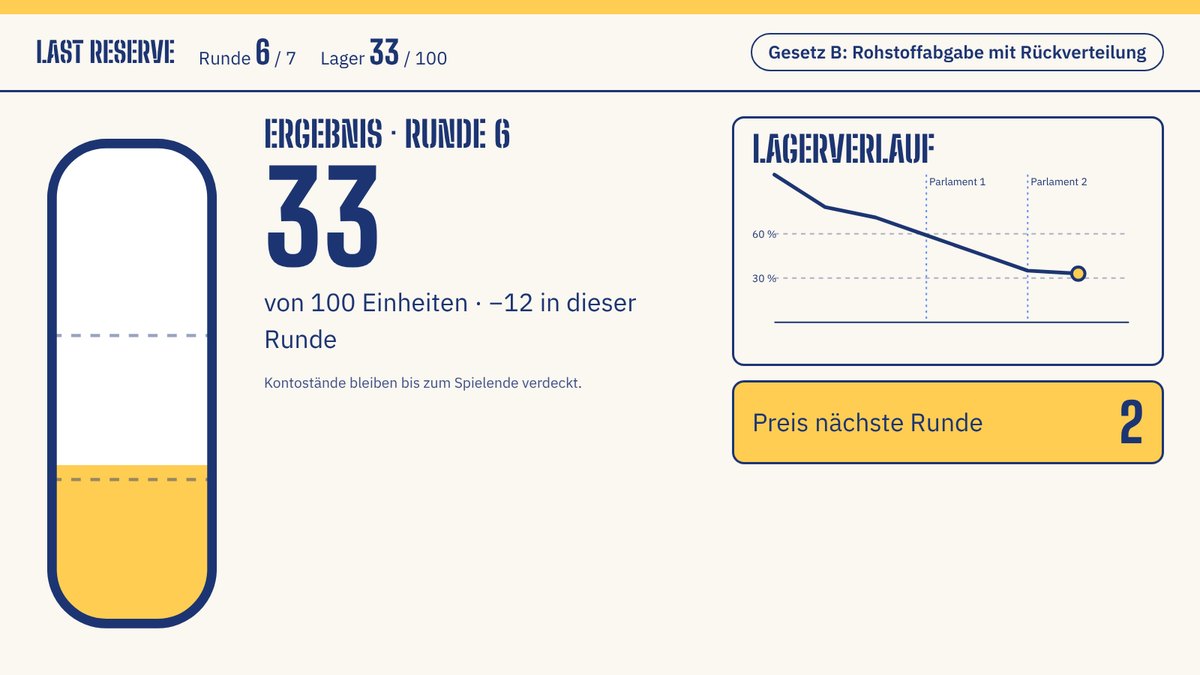
Over seven rounds, the businesses carry out orders, for which they need raw materials from the shared warehouse. The emptier the warehouse, the more expensive each unit becomes. Circular economy strategies cost money initially, but reduce demand for all subsequent rounds.
Each team plays on a laptop. They view the shared warehouse as a silo, their own business with crates, strategies and company value, and, before making a decision, can see what each choice means for their account and the warehouse. The app calculates everything, whilst the teacher guides the game with a single button.
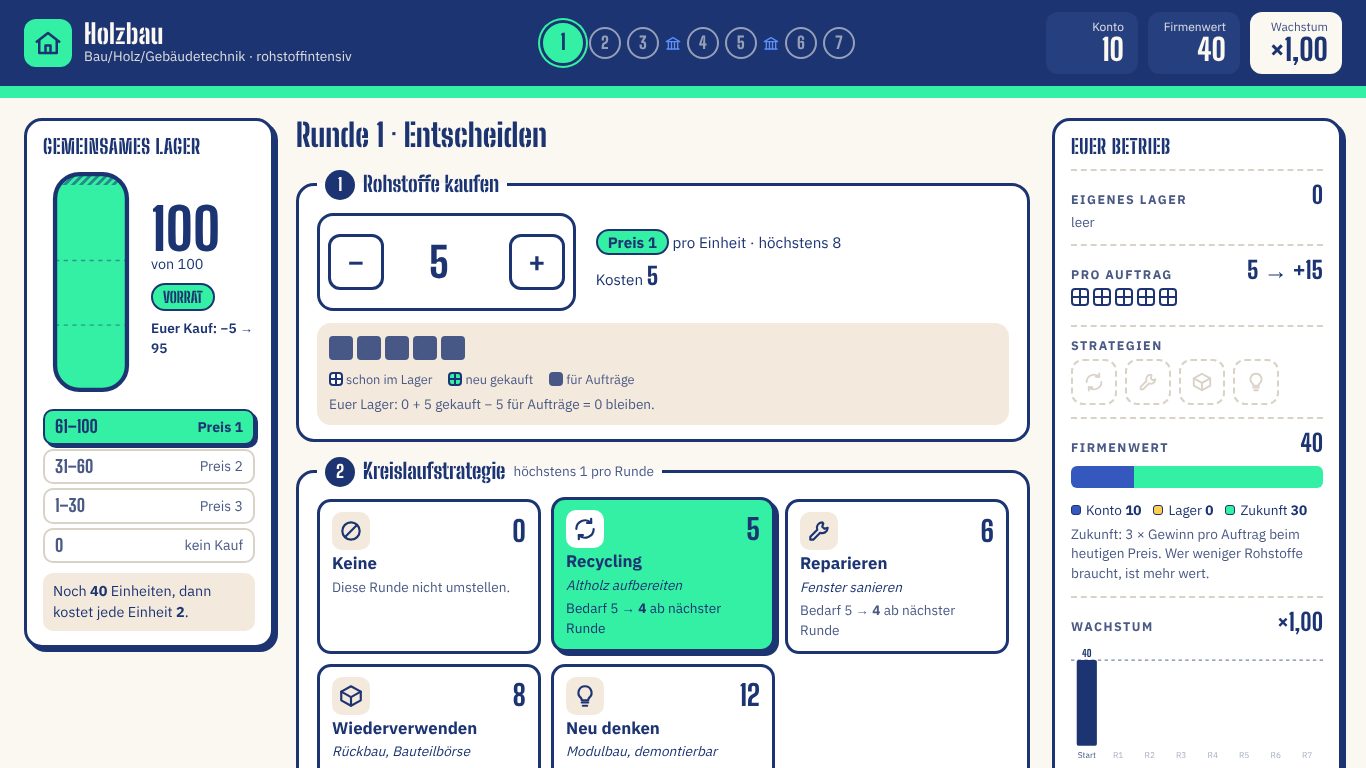
Decide
Each team makes its decisions in secret on its laptop: how many raw materials to buy, whether to invest in a circular economy strategy, and how many orders to fulfil.
Events
An economic boom, a supply bottleneck, the discovery of a raw material in a conflict-ridden region: events are changing the situation.
Parliament
Twice, the class acts as a parliament and votes on laws, such as a raw materials levy or a take-back obligation. Each law affects the various sectors differently.
Balance sheet
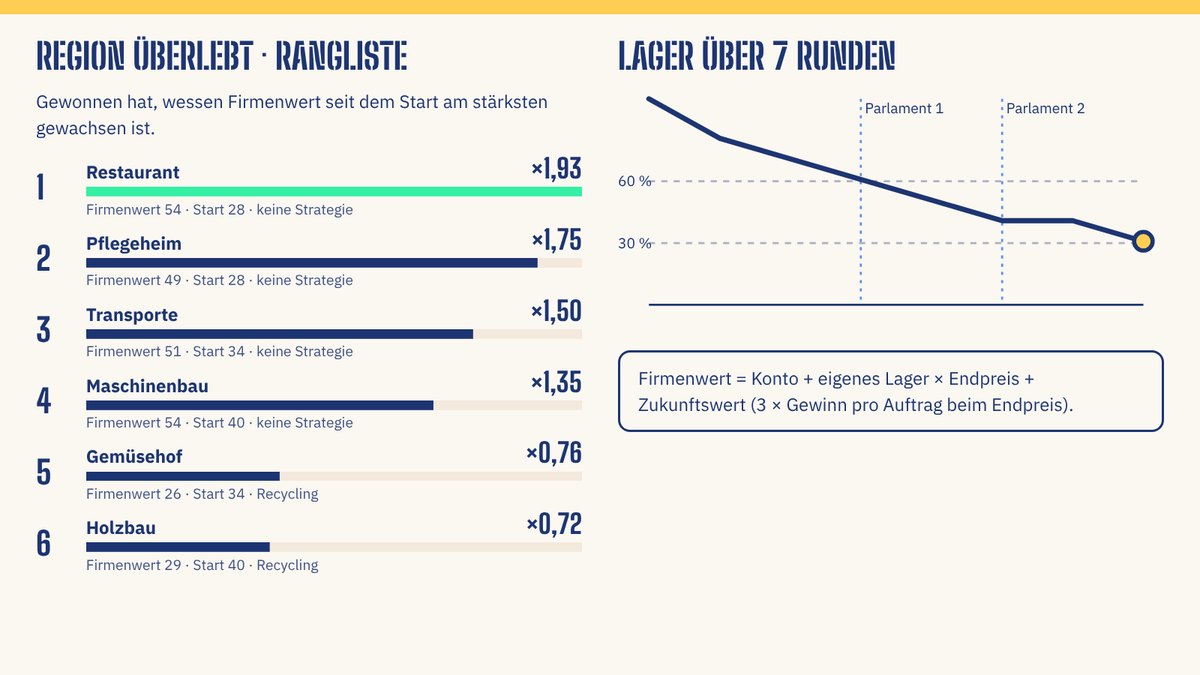
If the region survives, the business whose value has grown the most wins. If the warehouse runs out of stock, nobody wins.
Learning objectives
Learners can …
Recognising limits
…explain why a linear economic model reaches its limits when raw materials are finite.
Classify R-strategies
…distinguish between repair, reuse, recycling and rethinking, and classify them according to their impact.
Justifying conflicting objectives
…explain the conflict between short-term profit and long-term supply in the context of your own decisions.
Taking political action
…as legislators, to vote on rules governing a shared resource and to assess who a law benefits and who it burdens.
Apply
…propose a circular economy initiative for your own training organisation.
We are looking for test classes
Last Reserve is brand new. Before the game is made available to everyone, we’d like to test it with real classes. To do this, we’re looking for ABU teachers who’d like to play Last Reserve with their class and provide us with feedback.
You can get started straight away: register at lastreserve.future-perfect.ch, create a game and play it with your class. You’ll find the feedback form after logging in, either before or after the game. Your experiences will be incorporated directly into the game’s further development: rules, time required, clarity and evaluation.
How a test works
-
Register
You register on lastreserve.future-perfect.ch using your email address and set a password.
-
Create a game
You select your class and companies. It takes about two minutes.
-
Play
You’re playing with your class: a projector for everyone, one laptop per team. The pupils don’t need an account.
-
Give feedback
In the login area, you’ll find a short feedback form which you can fill in before or after the match. We read every piece of feedback.